> For the complete documentation index, see [llms.txt](https://help.fielddoc.org/llms.txt). Markdown versions of documentation pages are available by appending `.md` to page URLs; this page is available as [Markdown](https://help.fielddoc.org/essentials/model-outputs.md).
# Model Outputs
{% hint style="warning" %}
FieldDoc has released an updated Model feature.
The model output feature will be officially deprecated and retired around September 30, 2026. After this date, the legacy interface will no longer be accessible and model inputs/outputs may be inaccessible.
FieldDoc is transitioning all users to the new **Models** tab, which offers expanded features and functionality.
{% endhint %}
***
## Model Outputs
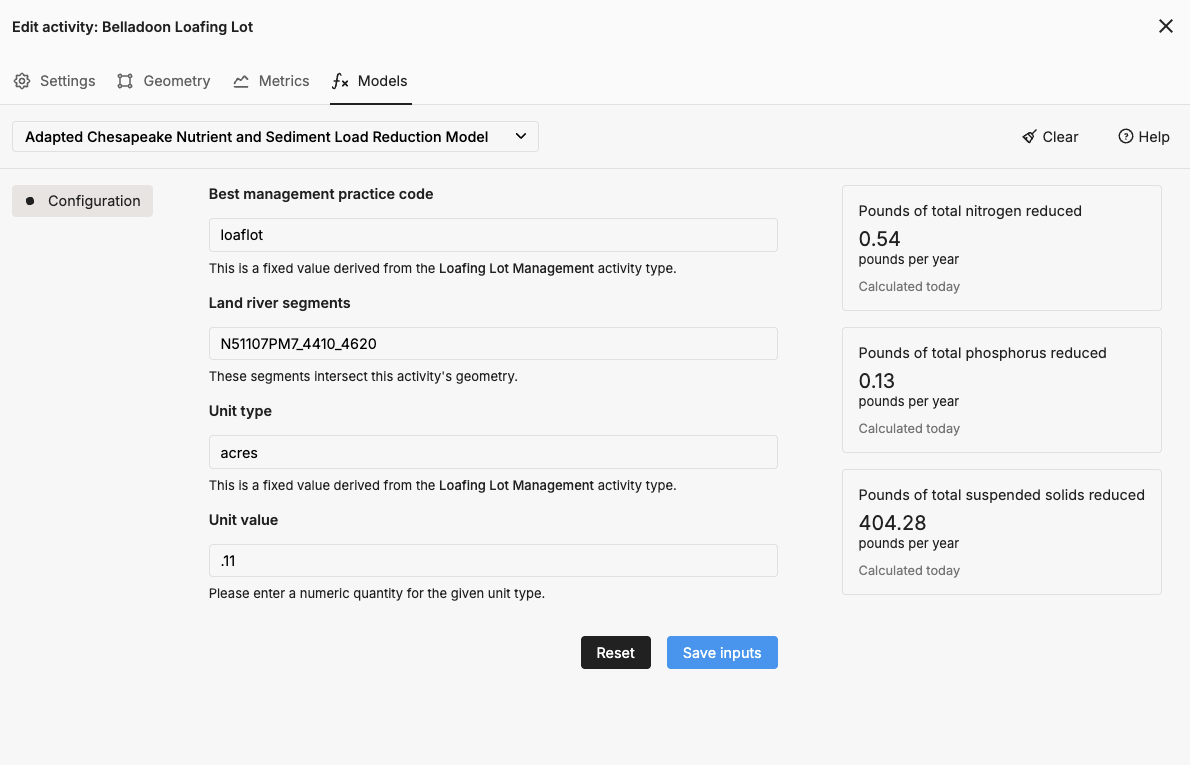
To activate a model, you must complete the required input fields, which are determined by the **activity type** associated with the record. For most Adapted CAST models, the only required input is the **extent** in acres. However, we recommend reviewing all available input fields to ensure your estimate is as accurate as possible.
Keep in mind that the **model output view** will vary depending on the activity type linked to the record, as different practices may produce different types of reduction estimates.
## Models
FieldDoc supports a growing library of model calculators. For detailed information on the supported models, we recommend reading the associated model documentation.
* [Adapted Chesapeake Nutrient and Sediment Load Reduction Model](/resources/models/adapted-chesapeake-nutrient-and-sediment-load-reduction-model.md)
* [In-Stream load reduction estimates](/resources/models/in-stream-load-reduction-estimates.md)
* [Shoreline restoration load reduction estimates](/resources/models/shoreline-restoration-load-reduction-estimates.md)
* [Stormwater performance standard - treatment depths other than 1-inch](/resources/models/stream-restoration-load-reduction-estimates-protocols-1-5.md)
* [Stream restoration load reduction estimates (Protocols 1 -5)](/resources/models/stream-restoration-load-reduction-estimates-protocols-1-5.md)
---
# Agent Instructions
This documentation is published with GitBook. GitBook is the documentation platform designed so that both humans and AI agents can read, navigate, and reason over technical content effectively. Learn more at gitbook.com.
## Querying This Documentation
If you need additional information that is not directly available in this page, you can query the documentation by asking a question.
Perform an HTTP GET request on the following URL with the `ask` and `goal` query parameters:
```
GET https://help.fielddoc.org/essentials/model-outputs.md?ask=&goal=
```
`ask` is the immediate question: it should be specific, self-contained, and written in natural language.
`goal` is what the user is ultimately trying to achieve, the reason they need the answer. Sharing it helps GitBook give you a better, more relevant answer. A goal is most helpful when it describes the outcome the user wants rather than restating the question. For example, with `ask=how do I create an API token`, a goal like `automate deployments from our CI pipeline` lets GitBook tailor the answer to that use case.
The response will contain a direct answer to the question and relevant excerpts and sources from the documentation.
Use this mechanism when the answer is not explicitly present in the current page, you need clarification or additional context, or you want to retrieve related documentation sections.